Cambio - Excellence in Molecular Biology

Search
Isothermal Nucleic Acid Amplification

Isothermal Nucleic Acid Amplification: RPA Optimization Enzymes & Kits

Isothermal Nucleic Acid Amplification Kits, Enzymes, and Lysis Solutions


Since 2016, Intact Genomics has pioneered the development and manufacture of products for isothermal nucleic acid amplification. Our comprehensive portfolio includes RPA master mixes and kits, individual RPA enzymes, glycerol-free and lyophilized formats  and helicase-based amplification enzymes. Learn more by downloading our white paper on RPA technology and Intact Genomics RPA products.

Designed for rapid, sensitive nucleic acid amplification without conventional thermal cycling, our products support molecular diagnostic development, point-of-care and agricultural testing, and life science research. Through continued innovation, consistent quality, and reliable performance, we help researchers and industry partners accelerate discovery and develop next-generation testing solutions. Bulk quantities, custom formulations, CDMO and OEM services are also available.

Product Links

Package Size

Features

IG® RPA Master Mix

25 rxns, 100 rxns, 500 rxns

Delivers powerful isothermal amplification for molecular diagnostics and research. Easy-to-use, fast, reliable, and cost-effective.

IG® RPA Master Mix - Lyophilized(opens in new tab)

24 rxns, 96 rxns, 480 rxns

A ready-to-use, freeze-dried premix for rapid and sensitive isothermal DNA amplification.

IG® Recombinase Polymerase Amplification (RPA) Kit v2

25 rxns, 100 rxns, 500 rxns

Provides faster and more discernible results for isothermal DNA amplification.

IG® Recombinase Polymerase Amplification (RPA) Kit

25 rxns, 100 rxns, 500 rxns

Contains the reagents and enzymes needed for DNA amplification.

T4 UvsX DNA Recombinase(opens in new tab)

100 μg, 500 μg, 1000 μg

Important for error-free repair of DNA double-strand breaks and replication fork restart.

T4 UvsY Protein

100 μg, 500 μg, 1000 μg

Phage T4 recombination mediator protein that stimulates filament nucleation.

T4 gp32 Protein

100 μg, 200 μg, 500 μg

Single-stranded DNA-binding protein involved in DNA replication, recombination, and repair.

Bsu DNA Polymerase Large Fragment

1,000 units

Polymerase useful for extending primers in RPA.

Sau DNA Polymerase Large Fragment

1,000 units

Polymerase useful for extending primers in RPA.

Glycerol Free or Lyophilized T4 UvsX DNA Recombinase

100 μg, 500 μg, 1000 μg

Supports error-free DNA double-strand break repair and replication fork restart.

Glycerol Free or Lyophilized T4 UvsY Protein

100 μg, 500 μg, 1000 μg

Recombination mediator protein that stimulates filament nucleation.

Glycerol Free or Lyophilized T4 gp32 Protein

500 μg

Single-stranded DNA-binding protein for DNA replication, recombination, and repair.

Glycerol Free or Lyophilized Bsu DNA Polymerase Large Fragment

1,000 units

Polymerase useful for extending primers in RPA.

Exonuclease III

10,000 units, 25,000 units

Digests one strand of duplex DNA from blunt ends, 5′ overhangs, or nicks.

Endonuclease IV (Nfo)

2,000 units, 5,000 units

Functions as an apurinic/apyrimidinic nuclease and 3′-terminal di-esterase for DNA repair.

Tte MutL Protein(opens in new tab)

(opens in new tab)20 µg, 400 µg

A thermostable ATPase accessory protein that interacts with Tte UvrD helicase, suitable for mismatch repair studies, helicase regulation, and isothermal DNA amplification development.

Tte UvrD Helicase(opens in new tab)

2 µg, 40 µg

A thermostable, ATP-dependent DNA helicase and key enzyme for HDA, suitable for isothermal nucleic acid amplification, DNA-unwinding studies, helicase activity assays, and primer- or probe-based detection workflows.

igSuper™ Tte UvrD Helicase(opens in new tab)

(opens in new tab)2 µg, 40 µg

An engineered, thermostable ATP-dependent DNA helicase for HDA and other isothermal nucleic acid amplification, DNA-unwinding studies, and DNA detection workflows.


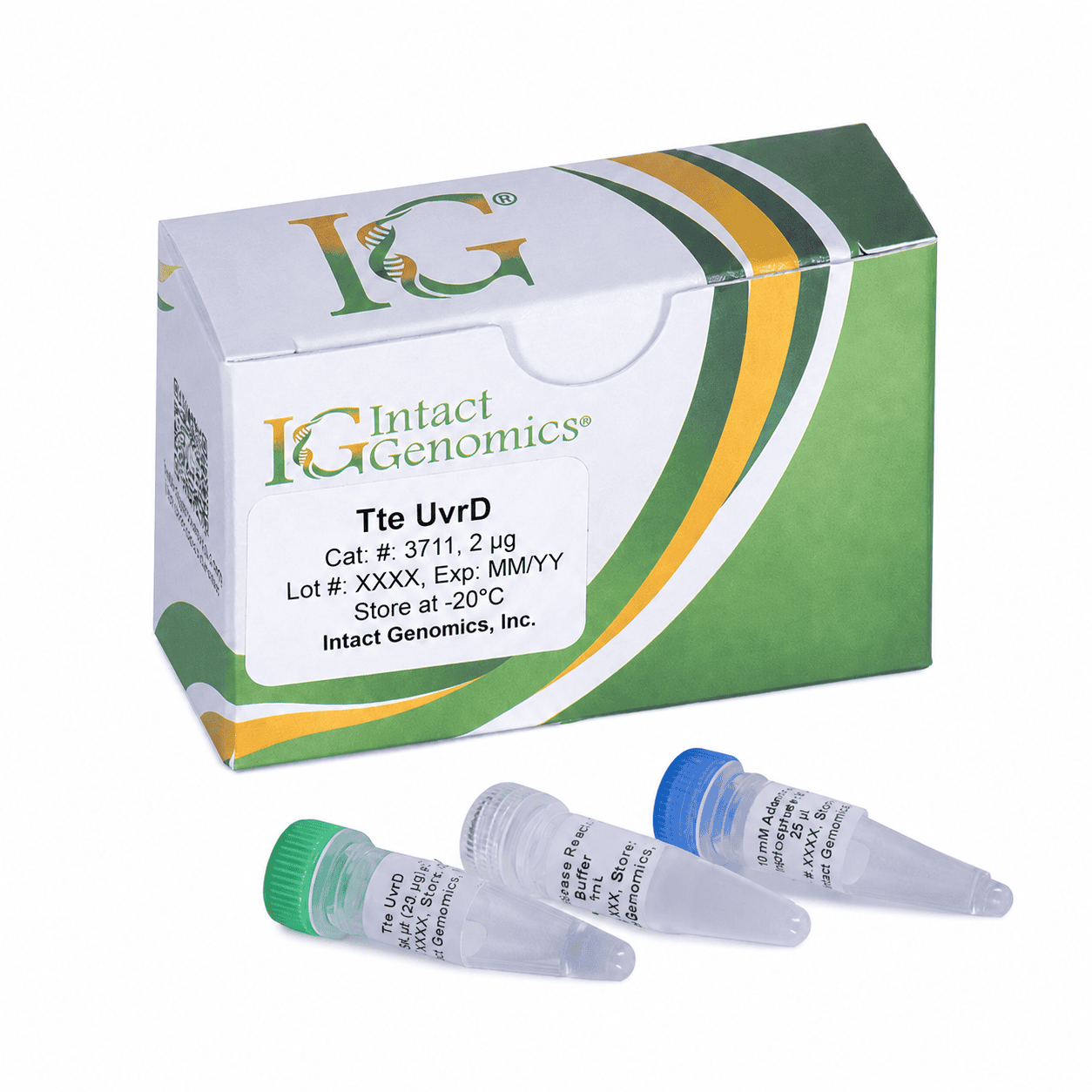
Tte UvrD Helicase

Tte UvrD Helicase is a thermostable, ATP-dependent DNA helicase derived from Thermoanaerobacter tengcongensis. Active at temperatures up to 65°C, it efficiently unwinds double-stranded DNA to generate single-stranded templates without thermal cycling. Tte UvrD is a key enzyme for helicase-dependent amplification (HDA) and is suitable for isothermal nucleic acid amplification, DNA-unwinding studies, helicase activity assays, and primer- or probe-based detection workflows. Its compatibility with PCR-designed primers may help simplify assay development.
Intact Genomics

Catalogue No.DescriptionPack SizePriceQty
  • Change to:
IG-3711Tte UvrD Helicase2 µg (20 µg/ml) �218.96 Quantity
Add
IG-3713Tte UvrD Helicase40 µg (20 µg/ml) �1,254.26 Quantity
Add

Tte UvrD Helicase


Tte UvrD Helicase is a thermostable, ATP-dependent DNA helicase derived from Thermoanaerobacter tengcongensis. Active at temperatures up to 65°C, it efficiently unwinds double-stranded DNA to generate single-stranded templates without thermal cycling.

Tte UvrD is a key enzyme for helicase-dependent amplification (HDA) and is suitable for isothermal nucleic acid amplification, DNA-unwinding studies, helicase activity assays, and primer- or probe-based detection workflows. Its compatibility with PCR-designed primers may help simplify assay development.


Custom formats, package sizes and bulk pricing are available upon request.


Tte UvrD is a thermostable, ATP-dependent DNA helicase derived from the thermophilic bacterium Thermoanaerobacter tengcongensis (Tte). The enzyme unwinds double-stranded DNA (dsDNA), generating single-stranded DNA (ssDNA) that can be accessed by other proteins, enzymes, primers, and probes.

Intact Genomics Tte UvrD is a key enzyme used in helicase-dependent amplification (HDA)1. In HDA, Tte UvrD separates complementary DNA strands to generate single-stranded templates, allowing primer hybridization and DNA polymerase extension without the thermal cycling required for PCR. Studies have also shown that HDA may use the same primer sequences designed for PCR, helping simplify assay development².

Tte UvrD is a thermostable enzyme that originates from a thermophilic organism and it is active at temperatures up to 65 °C. It is suitable for HDA, DNA-unwinding studies, helicase activity assays, isothermal nucleic acid amplification, and other molecular biology applications requiring enzymatic strand separation.

Applications:

  • Helicase-dependent amplification (HDA)
  • Isothermal nucleic acid amplification
  • DNA strand-unwinding studies
  • Helicase activity assays
  • Probe- and primer-based DNA detection workflows

 Benefits:

  • Thermostable and active at temperatures up to 65 °C
  • Generates single-stranded DNA without thermal cycling
  • Supports primer hybridization and DNA polymerase extension
  • May be used with PCR-designed primers, simplifying assay development
  • Suitable for research and diagnostic assay development

 Source:

Recombinant UvrD expressed from a plasmid carrying the thermostable UvrD gene from Thermoanaerobacter tengcongensis.

 Specifications:

  • Purified recombinant Tte UvrD helicase
  • Molecular weight: 83 kDa
  • Free of detectable endonuclease activity

Product Components and Storage Temperature:
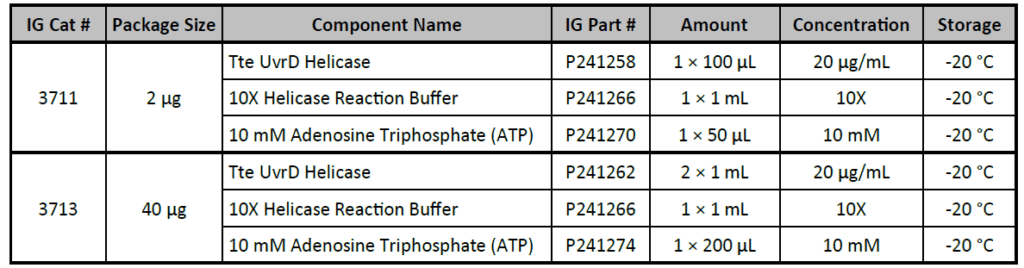

 Custom formats and package sizes are available upon request.

Quality Control:

Nuclease Activity: DNA integrity is evaluated after overnight incubation with concentrated enzyme. The DNA must remain intact, with no detectable degradation, compared with a no-enzyme control.
Enzyme Activity: At 24 nM (2 ng/µL), the enzyme must pass both ATPase and fluorescence-based helicase activity assays and demonstrate performance comparable to an approved UvrD batch-control standard.

References:
1. An, L. et al. Characterization of a Thermostable UvrD Helicase and Its Participation in Helicase-dependent Amplification *. Journal of Biological Chemistry 280, 28952–28958 (2005).
2. Gavrilov, M. et al. Engineered helicase replaces thermocycler in DNA amplification while retaining desired PCR characteristics. Nat Commun 13, 6312 (2022).


Protocol for DNA Helicase Activity:
The UvrD reaction measures ATP-dependent unwinding of complementary DNA strands.
1. Set up the reaction according to the table below.
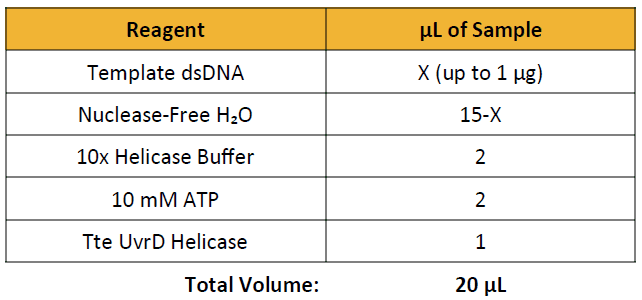
2. Incubate the reaction mixture at 65 °C for 20 minutes. The incubation time and temperature may be adjusted for different applications. Typical conditions range from 42–68 °C for 10–60 minutes. Note that ATP hydrolysis can limit helicase activity at higher temperatures.

3. To inactivate the enzyme, incubate the reaction at 80 °C for 15 minutes.


Tte UvrD Helicase Manual
Tte UvrD Helicas MSDS
IG Product Certificate of Origin – Tte UvrD Helicas

If you cannot find the answer to your problem then please contact us or telephone +44 (0)1954 210 200