Step 1: Design your custom 55-nucleotide oligo to use the IG®sgRNA synthesis kit
These steps will help to design the sequence of the target DNA oligos needed to use the kit. These oligos are not included and should be ordered and manufactured separately to use with this kit.
1. Use a target site selection webtool to find a 20 nucleotide sequence in your gene (ChopChop, for example). We will refer to your target sequence as “N20”.
2. To the 5’ end of N20, add the T7 promotor with a guanine at the 3’ position. A final “G” is important for RNA transcription although it is not part of the T7 promoter. It also gets incorporated into the final sgRNA product.
5’-TTCTAATACGACTCACTATAG(N20)-3’
3. The 3’ end of N20 needs to overlap with the IG Cas9 scaffold. Add the following scaffold overlap sequence:
5’-TTCTAATACGACTCACTATAG(N20)GTTTTAGAGCTAGA -3’
The custom 55-nucleotide oligo you need to order/manufacture before using the IG® sgRNA synthesis kit is:
TTCTAATACGACTCACTATAG(N20)GTTTTAGAGCTAGA
where “N20” is YOUR 20-nucleotide target sequence that you identified in step 1.
Custom Oligo Design EXAMPLE:
We use a specific sgRNA targeted sequence as an example as below:
A. Target-specific DNA sequence for sgRNA is selected.
Example: 5’ G AAGGCAATTGATCAATTCTGGG 3’
Remove these three nucleotides: the PAM sequence (NGG, which are NOT highlighted in red) is required for Cas9 recognition of the target site and is NOT part of the sgRNA sequence as BELOW:
5’ GAAGGCAATTGATCAATTCT 3’
B. Add “G” to the 3’ end of T7 promoter sequence highlighted in blue to ensure transcription because at least one G is necessary for efficient T7 RNA polymerase binding. Then, attach it to the above DNA sequence of the specific sgRNA BELOW:
5’ TTCTAATACGACTCACTATAGGAAGGCAATTGATCAATTCT 3′
C. Append the 14 nucleotide-overlap DNA sequence shown in pink, the example DNA oligo of a total length of 55 bp is to be ordered. Shown BELOW:
5’ TTCTAATACGACTCACTATAGGAAGGCAATTGATCAATTCTGTTTTAGAGCTAGA 3′
D. The IG® sgRNA synthesis kit includes the oligo shown below. This sequence matches the S. pyogenes Cas9 scaffold DNA sequence:
5′ AAAGCACCGACTCGGTGCCACTTTTTCAAGTTGATAACGGACTAGCCTTATTTTAACTTGCTATTTCTAGCTCTAAAAC 3′
When setting up the IG® sgRNA synthesis reaction, the overlapped DNA oligos are oriented as shown below:
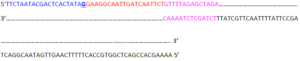
Following completion of the incubation, the double-stranded DNA reaction product from DNA polymerase activity is shown below:
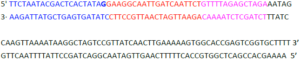
The final example sgRNA sequence is:
5′ GGAAGGCAAUUGAUCAAUUCUGUUUUAGAGCUAGAAAUAGCAAGUUAAAAUAAGGCUAGUCC
GUUAUCAACUUGAAAAAGUGGCACCGAGUCGGUGCUUUU 3′
Step 2: Utilize the IG® sgRNA synthesis kits
You’ve done the hard part, now let Intact Genomics make this next part easy. Simply choose whether to follow the SMALL SCALE or the PREPARATIVE SCALE table in the protocol.
1. Prewarm an incubator or water bath for microcentrifuge tubes to 37°C.
2. Thaw each component of the IG sgRNA synthesis kit and keep the unmixed kit reagents on ice.
3. Prepare a 1 µM solution of your custom oligo.
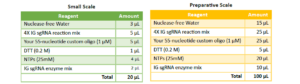
4. Choose to follow one of the two tables below. In a DNase/RNase-free 1.5 mL conical tube, mix the following IG® sgRNA synthesis kit components IN ORDER at room temperature. (CHOOSE either the “Small Scale” OR the “Preparative Scale”).
6. Mix thoroughly by tapping or flicking the tube 10 times, (do not vortex) and centrifuge the reaction droplets (for less than 5 seconds) to the bottom of the tube in a microcentrifuge. This mixture is the sgRNA synthesis reaction.
7. Transfer the sgRNA mixture to the prewarmed 37°C incubator for 30 minutes. The reaction is usually complete in about 25 minutes, and there are no negative effects if left for under an hour at 37°C.
8. Transfer the reaction to ice.
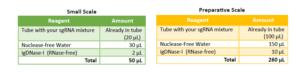
9. Add IG® DNase-I (RNase-Free) and Nuclease-free Water as described in the table below that matches your choice of “Small Scale” or “Preparative Scale”:
9. Mix thoroughly by tapping the tube 10 times and centrifuge (less than 5 seconds) all sample droplets to the bottom of the tube in a microcentrifuge.
10. Transfer the sgRNA mixture to the prewarmed 37°C incubator for 15 minutes.
11. For in vitro downstream CRISPR applications we recommend purifying the RNA using the IG® sgRNA purification kit (follow the sgRNA purification protocol) or analyzing your sgRNA by gel electrophoresis using RNase-free tips, tubes and buffers.
If you cannot find the answer to your problem then please contact us or telephone +44 (0)1954 210 200