Cambio - Excellence in Molecular Biology

Search
Competent Cells

Competent Cells: Methionine and Thymidine Auxotrophic Agrobacteria Competent cells

High Efficiency Chemically & Electro Competent Agrobacterium Cells


Intact Genomics (IG) is the largest and earliest provider of agrobacterium competent cells in the market. We provide the highest quality agrobacterium competent cells to customers and distributors worldwide. We also developed the first high-efficiency chemically agrobacterium competent cells in 2020. Using propriety methods, Intact Genomics has developed and manufactured a variety of Agrobacterium competent cells to support the development of plant transformation and agricultural research.


Methionine and Thymidine Auxotrophic Agrobacteria

Competent Cells

We also provide a variety of highly unique strains. This includes Methionine and Thymidine Auxotrophic Agrobacteria competent cells. After transformation, antibiotics are commonly used to remove Agrobacterium. However, even in the presence of antibiotics, there can be overgrowth of the Agrobacterium strain. Auxotrophic Agrobacteria help to solve this problem. Methionine or Thymidine Auxotrophic Agrobacterium strains include modifications so that they will not grow unless methionine or thymidine is added to Minimal medium. Using the selections of minimal media without Methionine or Thymidine in combination with selective antibiotics, it completely prevents the bacteria from overgrowing plant tissues during plant transformation.

Intact Genomics’ Methionine Agrobacterium strains were originally cloned and provided by Dr. Wayne Parrott’s lab under license from University of Georgia. Thymidine Agrobacterium strains were originally cloned and provided by Dr. Kan Wang’s lab under license from Iowa State University. Knocking out genes to cause auxotrophy does not affect transformation capacity.

Benefits Include

  • Enables development of more efficient transformation systems.
  • Reduced bacterial overgrowth during co-cultivation.
  • Decreased need for antibiotics.
  •  

Scroll down to find our collection of  Methionine and Thymidine Auxotrophic Agrobacteria competent cells.

Product

Efficiency

Application & Benefits

Methionine Auxotrophic LBA4404 Agrobacterium Chemically Competent Cells

≥1.0 x 10^5

Transgenic operations of tomatoes, tobacco and other plants

Methionine Auxotrophic LBA4404 Agrobacterium ElectroCompetent Cells

≥1.0 x 10^7

Methionine Auxotrophic EHA105 Agrobacterium Chemically Competent Cells

≥1.0 x 10^5

Transgenic operations of rice, tobacco and other plants

Methionine Auxotrophic EHA105 Agrobacterium Electrocompetent Cells

≥1.0 x 10^7

Thymidine Auxotrophic EHA105 Agrobacterium Electrocompetent Cells

≥1.0 x 10^3

For electroporation transformation to rice, tobacco and other plants.

Thymidine Auxotrophic EHA101 Agrobacterium Electrocompetent Cells

≥1.0 x 10^3

Thymidine Auxotrophic EHA105D Agrobacterium Electrocompetent Cells

≥1.0 x 10^3

Thymidine Auxotrophic EHA105 Agrobacterium Chemically Competent Cells

≥1.0 x 10^3

For chemically transformation to rice, tobacco and other plants

Thymidine Auxotrophic EHA101 Agrobacterium Chemically Competent Cells

≥1.0 x 10^3

Thymidine Auxotrophic EHA105D Agrobacterium Chemically Competent Cells

≥1.0 x 10^3


LBA4404 Agrobacterium Chemically Competent Cells

The LBA4404 strain is useful for transgenic operations of tomatoes, tobacco and other plants.

Intact Genomics

Catalogue No.DescriptionPack SizePriceQty
  • Change to:
IG-1085-06LBA4404 Agrobacterium Chemically Competent Cells6x50µl �276.08 Quantity
Add
IG-1085-10LBA4404 Agrobacterium Chemically Competent Cells10x50µl �421.26 Quantity
Add
IG-1085-18LBA4404 Agrobacterium Chemically Competent Cells18x50µl �634.27 Quantity
Add

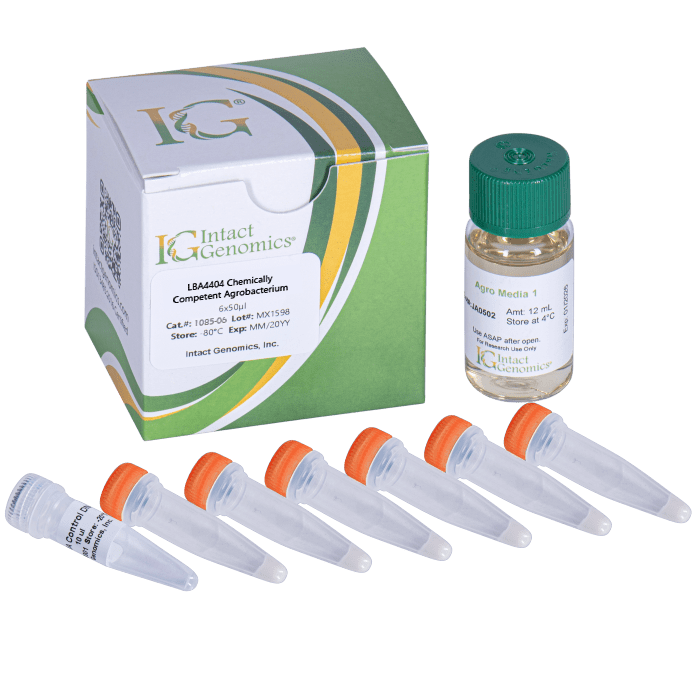
Intact Genomics LBA4404 Agrobacterium Chemically Competent Cells are optimized for the highest transformation efficiencies which is ideal for applications such as cDNA or gDNA library construction. The LBA4404 strain is useful for transgenic operations of tomatoes, tobacco and other plants. LBA4404 contains a rifampicin resistance gene (rif). LBA4404 strain also contains an octopine-type Ti plasmid pAL4404 without self-transport function, which contains the vir gene.


Specifications
Competent cell type: Chemically Competent
Species: A. tumefaciens
Strain: LBA4404
Format: Tubes
Transformation efficiency: ≥ 1 x 10⁵ cfu/µg pCAMBIA1391z DNA
Blue/white screening: No
Shipping condition: Dry ice


Reagents Included

  • LBA4404 Agrobacterium Chemically Competent Cells
  • DNA (pCAMBIA1391z, 500 pg/µl)
  • Recovery medium

Note: Liquid nitrogen is required.


Storage
LBA4404 Agrobacterium Chemically Competent Cells: -80 ºC
pCAMBIA1391z control DNA: -20 ºC
Recovery medium: 4 ºC


Quality Control
Transformation efficiency is tested by using the pCAMBIA1391z control DNA supplied with the kit and using the protocol in this manual. Transformation efficiency should be ≥1 x 10⁵ CFU/µg pCAMBIA1391z DNA. Untransformed cells are tested for appropriate antibiotic sensitivity.


General Guidelines

Follow these guidelines when using LBA4404 Agrobacterium Chemically Competent Cells:

  • Handle competent cells gently as they are highly sensitive to changes in temperature or mechanical lysis caused by pipetting.
  • Thaw competent cells on ice and transform cells immediately following thawing. After adding DNA, mix by tapping the tube gently. Do not mix cells by pipetting or vortexing.


Calculation of Transformation Efficiency
Transformation Efficiency (TE) is defined as the number of colony forming units (cfu) produced by transforming 1µg of plasmid into a given volume of competent cells.

TE = Colonies/µg/Plated

Transform 1 µl of (500 pg/µl) pCAMBIA1391z control plasmid into 50 µl of cells, add 950 µl of Recovery Medium. Recover for 3 hours and plate 100 µl. Count the colonies on the plate in two days. If you count 5 colonies, the TE is calculated as follows:

Colonies = 5
µg of DNA = 0.0005
Dilution = 100/1000 = 0.1
TE = 5/.0005/.1 = 1×10⁵


Please note, all agrobacterial strains are not well studied for antibiotic resistance and there are many agrobacterial strains. Therefore, it is the customer’s responsibility to make sure his/her vectors are compatible with the Agrobacterial strains if he/she uses an alternate antibiotic selection than kanamycin-selection.

If you cannot find the answer to your problem then please contact us or telephone +44 (0)1954 210 200

Transformation Protocol

Use this procedure to transform LBA4404 Chemically Competent Agrobacterium cells. Do not use these cells for electrocompetent transformation.

1) Place microcentrifuge tubes on ice.

2) Remove competent cells from the -80 °C freezer and thaw completely on wet ice (10-15 minutes).

3) Aliquot 1 µl (10pg -1 µg) of DNA to the chilled microcentrifuge tubes on ice.

4) When the cells are thawed, add 50μl of cells to each DNA tube on ice and mix gently by tapping 4-5 times. For the pCAMBIA1391z control, add 1 µl of (500 pg/µl) DNA to the 50 µl of cells on ice. Mix well by tapping. Do not pipette up and down or vortex to mix, this can harm cells and decrease transformation efficiency.

5) Keep tubes on ice for 5 minutes, and then transfer to liquid nitrogen for 5 minutes.

6) Incubate tubes for additional 5 minutes in 37°C water bath.

7) Immediately add 950µl of Recovery Medium or any other medium of choice to the tube, pipette up and down three times to re-suspend the cells.

8) Incubate tubes at 30 °C for 3 hours at 200 RPM.

9) Dilute the cells as appropriate then spread 20-200 μl cells onto a pre-warmed selective plate. For the pCAMBIA1391z control, you may plate 100 μl of undiluted transformation mix onto a YT plate containing 15 μg/ml rifampicin and 50 μg/ml kanamycin. Use a sterilized spreader or autoclaved ColiRoller™ plating beads to spread evenly.

10) Incubate the plates for 2 – 3 days at 30 °C.

If you cannot find the answer to your problem then please contact us or telephone +44 (0)1954 210 200

Manual – LBA4404 Chemically Competent Agrobacterium (download from manufacturer website here)

MSDS – LBA4404 Chemically Competent Agrobacterium (download from manufacturer website here)

If you cannot find the answer to your problem then please contact us or telephone +44 (0)1954 210 200