IG C41(DE3) Electrocompetent Cells
Struggling to express toxic or difficult proteins? Intact Genomics (IG®) C41(DE3) Electocompetent Cells are engineered to improve tolerance to toxic protein expression while maintaining reliable T7-driven performance. Derived from BL21(DE3), C41(DE3) strain reduces cell death associated with membrane proteins, nucleases, and other challenging targets. When standard BL21(DE3) fails, C41(DE3) helps move your project forward.
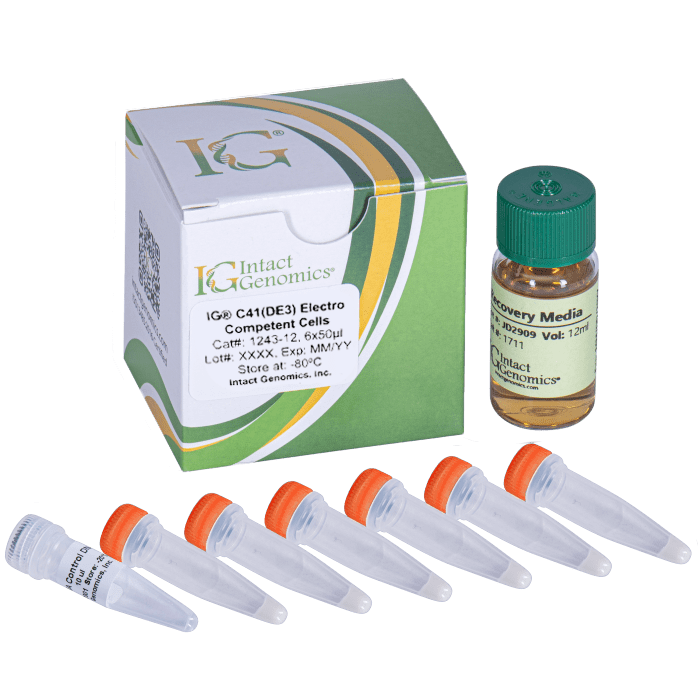
Custom formats, custom package sizes and bulk pricing are available upon request.
Product Description
Intact Genomics (IG®) C41(DE3) Electrocompetent Cells are designed for transformation and routine recombinant protein expression from vectors under an IPTG-inducible T7 promoter. The C41(DE3) strain is a BL21(DE3) mutant originally selected as survivor cells overexpressing the toxic oxoglutarate-malate carrier protein (OGCP). It carries lacI and additional mutations that help prevent cell death associated with the expression of many toxic recombinant proteins.
IG® C41(DE3) Electrocompetent Cells enable efficient expression of toxic proteins from a wide range of organisms, including viruses, bacteria, yeasts, plants, animals, and mammals. The effectiveness of the C41(DE3) strain for expressing toxic proteins has been demonstrated in a patent and validated in more than 400 publications.
Specifications:
Competent cell type: Electro competent
Species: E. coli
Strain: C41(DE3)
Format: Tubes
Transformation efficiency: ≥ 1.0 x 10¹⁰ cfu/µg pUC19 DNA
Blue/white screening: No
Shipping condition: Dry ice
Reagents Needed for One Reaction
IG® C41(DE3) Electrocompetent cells: 25 µl
DNA (or pUC19 Control, 10 pg/µl): 1 µl
Recovery medium: 1 ml
Product Components and Recommended Storage Condition:
- IG® C41(DE3) Electrocompetent Cells: -80°C
- DNA (pUC19, 10 pg/µl): -20°C
- Recovery medium: 4°C
Genomic Features:
IG® C41(DE3) Electrocompetent Cells have the following features:
- T7 Expression Strain
- Selected for expression of toxic proteins
- Suitable for expression of toxic genes
Quality Control:
Transformation efficiency is tested by using the pUC19 control DNA supplied with the kit and the high efficiency transformation protocol listed below. Transformation efficiency should be ≥ 1.0 x 10¹⁰ CFU/µg pUC19 DNA.
Untransformed cells are tested for appropriate antibiotic sensitivity.
General Guidelines:
Follow these guidelines when using IG C41(DE3) Electrocompetent Cells.
- Handle competent cells gently as they are highly sensitive to changes in temperature or mechanical lysis caused by pipetting.
- Thaw competent cells on ice, and transform cells immediately following thawing. After adding DNA, mix by tapping the tube gently. Do not mix cells by pipetting or vortexing.
Transformation Efficiency Calculation:
Transformation Efficiency (TE) is defined as the number of colony forming units (cfu) produced by transforming 1µg of plasmid into a given volume of competent cells.
TE = Colonies/µg/Dilution
Transform 1 µl of (10 pg/µl) pUC19 control plasmid into 50 µl of cells, add 950 µl of Recovery Medium. Dilute 10 µl of this in 990 µl of Recovery Medium and plate 50 µl. Count the colonies on the plate the next day. If you count 100 colonies, the TE is calculated as follows:
Colonies = 100
µg of DNA = 0.00001
Dilution = 50/1000 x 10/1000 = 0.0005
TE = 100/.00001/.0005 = 2.0×10¹⁰
Click the IG® Calculator to Find Your Transformation Efficiency
High-Efficiency Transformation Protocol:
Use this procedure to transform IG® C41(DE3) Electrocompetent Cells. Do not use these cells for chemical transformation.
1. DNA/Cell Mixture Preparation
1.1. Remove competent cells from the –80 °C freezer and thaw completely on wet ice (10–15 minutes). Place sterile electroporation cuvettes and microcentrifuge tubes on ice. Bring IG Recovery Medium to room temperature.
1.2. Aliquot 1–5 µl DNA (1 pg–100 ng) into chilled microcentrifuge tubes on ice. If using the pUC19 control, add 1 µl pUC19 DNA (10 pg/µl) to a chilled microcentrifuge tube.
1.3. Once the cells are thawed, gently add 25 µl of competent cells to each DNA tube while keeping the mixture on ice. Mix gently by tapping the tube 4–5 times.
Do not pipette up and down or vortex, as this may damage the cells and reduce transformation efficiency.
2. Electroporation
2.1. Pipette 26 µl of the cell/DNA mixture into a chilled electroporation cuvette, avoiding bubbles. Quickly flick the cuvette downward to ensure the mixture settles evenly across the bottom of the cuvette, then proceed with electroporation.
Standard electroporation settings for E. coli:
Voltage: 1.8 kV, Resistance: 200 Ω, Capacitance: 25 µF, Cuvette gap: 0.1 cm.
3. Cell Recovery
3.1. Immediately add 974 µl of room-temperature IG Recovery Medium (or another suitable medium) to the cuvette. Gently pipette up and down three times to resuspend the cells.
3.2. Transfer the entire mixture to a culture tube (17 mm × 100 mm) and incubate in a 37 °C shaking incubator at 210 rpm for 1 hour.
4. Cell Plating
4.1. Prepare pre-warmed selection plates during the recovery period. Plates should be equilibrated to 37 °C and free of condensation to prevent contamination and mixed colonies.
4.2. Dilute the recovered cells 10–100X, if necessary, to obtain well-isolated colonies. Plate 20–200 µl of cells onto pre-warmed LB agar plates containing the appropriate antibiotic(s). For the pUC19 control, plate 50 µl of a 100X diluted transformation onto an LB plate containing 100 µg/ml ampicillin. Spread the cells evenly using a sterile spreader or autoclaved ColiRoller™ plating beads.
4.3. Incubate the plates overnight (12–16 hours) at 37 °C.
References:
1. Walker JE & Miroux B. US6361966.
2. Miroux B, Walker JE. J Mol Biol. 1996 260:289-98.
3. Dumon-Seignovert L, Cariot G, Vuillard L.Protein Expr Purif. 2004 37:203-6.
4. Wagner S, et al. Proc Natl Acad Sci U S A. 2008. PMID: 18796603
5. Kwon et. al. Sci Rep. 2015 5:16076
6. Zhang et. al. Microb Cell Fact. 2015 14:142.
7. Bajzert et. al. BMC Vet Res. 2022 18(1):409.
Downloads
IG C41(DE3) Electrocompetent Cells Manual
IG C41(DE3) Electrocompetent Cells MSDS
Certificate of Origin – IG C41(DE3) Electrocompetent Cells
If you cannot find the answer to your problem then please contact us or telephone +44 (0)1954 210 200