Cambio - Excellence in Molecular Biology

Search
Competent Cells

Competent Cells: IG® Ultra-High Efficiency Electrocompetent E. coli Cells

IG® Ultra-High Efficiency Electrocompetent E. coli Cells


Intact Genomics (IG®, ig®) offers the largest collections of high-quality competent cells on the market.

Originally founded as a BAC cloning company, Intact Genomics developed deep expertise in producing ultra-high-efficiency competent cells to enable transformation of very large plasmids (~300 kb) into E. coli. Over the years, this expertise—combined with continuous process optimization—has allowed us to consistently deliver exceptionally high transformation efficiencies and reliable performance.

Combining our scientists’ expertise and craftsmanship with state-of-the-art equipment, advanced protocols, and rigorous quality control standards, our competent cells provide the following advantages:

  • Exceptional Transformation Efficiency – Up to 10–100× higher than other leading brands.
  • Consistent Quality – Manufactured under an ISO 13485:2016-certified quality management system to ensure reliable lot-to-lot performance.
  • Competitive Pricing– High-performance products at affordable prices to help maximize your research budget.
  • Flexible Formats and Custom Services – We offer a broader range of formats than competitors, including tubes (multiple aliquot sizes), 96- and 384-well plates, and strip tubes. We also provide custom competent cell services tailored to your specific needs.

Application

Product 

Specialization

Efficiency

Routine Cloning

ig® 5-alpha Electrocompetent Cells

Routine cloning and sub-cloning, library construction (DNA <10 kb)

≥2.0 × 10¹⁰

ig® 10B Electrocompetent Cells

Routine cloning and sub-cloning, library preparation including large DNA >10 kb

≥5.0 × 10¹⁰

ig® XL1 Blue Max Electrocompetent Cells

Stable plasmid propagation with blue/white screening

≥5.0 × 10¹⁰

HB101 Electrocompetent Cells

Stable plasmid maintenance

≥5.0 × 10¹⁰

Specialized Cloning

igMax™ DH10B Electrocompetent Cells

Difficult large DNA fragment cloning, BAC library construction

≥5.0 × 10¹⁰

IG® Recombineering Electrocompetent Cells

Homologous recombination, DNA, plasmid, and BAC engineering

≥1.0 × 10¹⁰

ig® Stable 2 Electrocompetent E. coli Cells

Cloning direct repeat sequences (unstable DNA)

≥2.0 × 10⁹

ig® ccdB Resist™ Electrocompetent E. coli Cells

Propagation of plasmids containing the ccdB gene

≥1.0 × 10¹⁰

Staphylococcus aureus (S. aureus) RN4220 ElectroCompetent Cells

A gateway strain to enable DNA manipulation in Staphylococcus aureus

≥1 × 10⁵

Protein Expression

IG® Autoinduction DE3 ElectroCompetent Cells

Optimized for autoinduction of protein expression

≥1.0 × 10¹⁰

BL21(DE3) Electrocompetent Cells

Routine T7 protein expression

≥1.0 × 10¹⁰

BL21(DE3)pLysS ElectroCompetent Cells

Routine non-T7 protein expression

≥1.0 × 10¹⁰

IG® C41(DE3) Electrocompetent Cells

Improved expression of toxic proteins

≥1.0 × 10¹⁰

IG® C41(DE3)pLysS Electrocompetent Cells

Improved expression of toxic proteins with suppressed basal expression

≥1.0 × 10⁹

IG® C43(DE3) Electrocompetent Cells

Most tolerant of toxic proteins

≥1.0 × 10¹⁰

IG® C43(DE3)pLysS Electrocompetent Cells

Most tolerant of toxic proteins with suppressed basal expression

≥5.0 × 10⁹

Phage Display

TG1 Phage Display Electrocompetent Cells

Antibody phage display with amber suppressor

≥4.0 × 10¹⁰

SS320 Phage Display Electrocompetent Cells

Antibody phage display

≥5.0 × 10¹⁰

ER2738 Phage Display ElectroCompetent Cells

Peptide phage display with amber suppressor

≥4.0 × 10¹⁰

Medium

IG® Recovery Medium

Superior formulation for all competent cell transformations

High-efficiency

IG® Autoinduction Medium

Promotes high-yield growth of E. coli and high-level expression of T7 promoter-regulated recombinant proteins

High-efficiency


Custom Formats, Custom Package Sizes and Bulk Pricing Are Available Upon Request


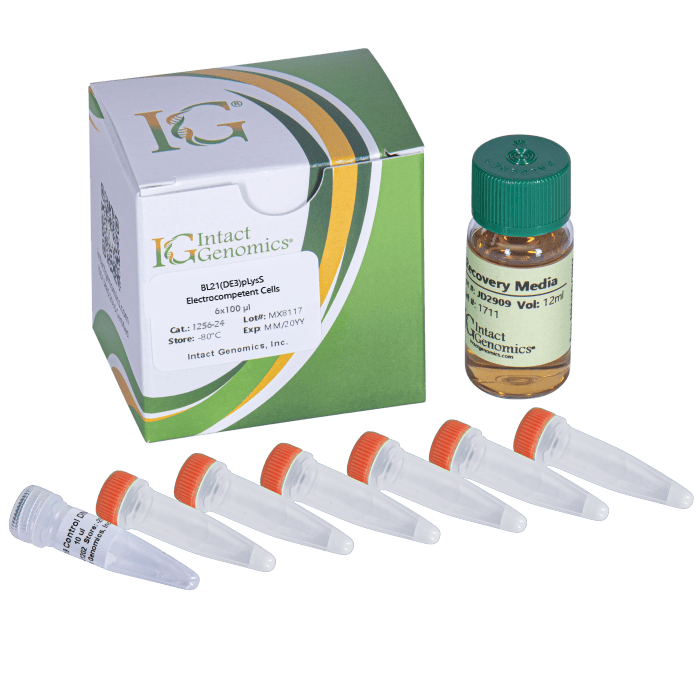
BL21(DE3)pLysS ElectroCompetent Cells

BL21(DE3)pLysS electrocompetent cells allow for tighter control of expression and are therefore suitable for the expression of toxic genes
Intact Genomics

Catalogue No.DescriptionPack SizePriceQty
  • Change to:
IG-1256-24BL21(DE3)pLysS ElectroCompetent Cells6x100µl £316.00 Quantity
Add
IG-1256-48BL21(DE3)pLysS ElectroCompetent Cells12x100µl £514.00 Quantity
Add

BL21(DE3)pLysS ElectroCompetent Cells


BL21(DE3)pLysS electrocompetent cells allow for tighter control of expression and are therefore suitable for the expression of toxic genes


Product Description

Intact Genomics (ig®) BL21(DE3)pLysS Electrocompetent Cells are suitable for transformation and routine protein expression. The pLysS plasmid produces T7 lysozyme that reduces base level expression of the gene of interest, subsequently allowing for tighter control of expression and is therefore suitable for expression of toxic genes. BL21(DE3)pLysS Electrocompetent Cells also carry the chloramphenicol resistance gene.

Competent cell type: Electrocompetent
Derivative of: BL21(DE3)pLysS
Species: E. coli
Format: Tubes
Transformation efficiency: ≥1 x 10¹⁰ cfu/µg pUC19 DNA
Blue/white screening: No
Shipping condition: Dry ice


Reagents Needed for One Reaction

ig® BL21(DE3)pLysS Electrocompetent Cells: 25 µl
DNA (or pUC19 Control, 10 pg/µl): 1 µl
Recovery medium: 1 ml


Storage

ig® BL21(DE3)pLysS Electrocompetent Cells: -80 ºC
pUC19 control DNA: -20 ºC
Recovery medium: 4 ºC


Genomic Features

ig® BL21(DE3)pLysS Electrocompetent Cells have the following features:

  • T7 Expression Strain
  • Deficient in both lon (1) and ompT proteases
  • Resistant to phage T1 (fhuA2)
  • B Strain
  • Suitable for expression of toxic genes


Genotype

F–pLysS, CmrompT hsdS(rB– mB–) gal dcm λ(DE3)


Quality Control

Transformation efficiency is tested by using the pUC19 control DNA supplied with the kit and using the protocol given below. Transformation efficiency should be ≥1 x 10¹⁰ CFU/µg pUC19 DNA. Untransformed cells are tested for appropriate antibiotic sensitivity.


General Guidelines

Follow these guidelines when using ig® BL21(DE3)pLysS ElectroCompetent Cells:

  • Handle competent cells gently as they are highly sensitive to changes in temperature or mechanical lysis caused by pipetting.
  • Thaw competent cells on ice and transform cells immediately following thawing. After adding DNA, mix by tapping the tube gently. Do not mix cells by pipetting or vortexing.

Note: A high-voltage electroporation apparatus such as Bio-Rad Gene Pulser II #165-2105, capable of generating field strengths of 16 kV/cm is required.


Example Calculation of Transformation Efficiency
Transformation Efficiency (TE) is defined as the number of colony forming units (cfu) produced by transforming 1µg of plasmid into a given volume of competent cells.


Use this procedure to transform BL21(DE3)pLysS Electrocompetent Cells. Do not use these cells for chemical transformation.
1. Place sterile cuvettes and microcentrifuge tubes on ice.
2. Remove competent cells from the -80 °C freezer and thaw completely on wet ice (10-15 minutes).
3. Aliquot 1 µl (1 pg-10 ng) of DNA to the chilled microcentrifuge tubes on ice.
4. When the cells are thawed, add 25 μl of cells to each DNA tube on ice and mix gently by tapping 4-5 times. For the pUC19 control, add 1 µl of (10 pg/µl) DNA to the 25 µl of cells on ice. Mix well by tapping. Do not pipette up and down or vortex to mix, this can harm cells and decrease transformation efficiency.
5. Pipette 26 µl of the cell/DNA mixture into a chilled electroporation cuvette without introducing bubbles. Quickly flick the cuvette downward with your wrist to deposit the cells across the bottom of the well and then electroporate.
6. Immediately add 974 µl of Recovery Medium or any other medium of choice to the cuvette, pipette up and down three times to re-suspend the cells. Transfer the cells and Recovery Medium to a culture tube.
7. Incubate tubes at 37 °C for 1 hour at 210 rpm.
8. Dilute the cells as appropriate then spread 20-200 μl cells onto a pre-warmed selective plate. For the pUC19 control, plate 50 μl of diluted transformants onto an LB plate containing 100 μg/ml ampicillin. Use sterilized spreader or autoclaved ColiRoller™ plating beads to spread evenly.
9. Incubate the plates overnight at 37 °C.


Downloads

Manual – BL21(DE3)pLysS Electrocompetent Cells

MSDS – BL21(DE3)pLysS Electrocompetent Cells

If you cannot find the answer to your problem then please contact us or telephone +44 (0)1954 210 200