Cambio - Excellence in Molecular Biology

  • Skip to page content
  • Skip to primary navigation
Cambio - Excellence in Molecular Biology
  • Home
  • Products
  • Special Offers
  • About Us
    • Distributors
    • Suppliers
    • News
    About Us
    Distributors Suppliers News
  • Contact Us
    • Our Location
    • Technical Help
    Contact Us
    Our Location Technical Help
  • My Account
    • Sign In
    • Opt-In
    • Password Reminder
    • Create Account
    • Orders & Quotes
    My Account
    Sign In Opt-In Password Reminder Create Account Orders & Quotes
  • Contact Us
Aptamers
  • Catalogue Aptamers (87)
  • Modifications (6)
  • Custom Aptamer Synthesis
  • Applications
  • Aptamers & Sensors
  • Aptamer Handling - Best Practices
Antibodies
  • Collagenase (1)
  • TIMP (1)
  • Fibrinogen (1)
  • Plasminogen (1)
  • Other (2)
  • Streptokinase (1)
  • Urokinase (1)
  • Peptide-generated (1)
Biopharma Quality Control
  • Pyrogen testing (4)
  • Residual Host DNA Testing (2)
  • Vector Copy Number Determination (2)
  • AAV Vector Titer Determination (3)
  • Mycoplasma and Bacteria Testing (10)
Buffers (custom)
Cell Culture Contamination Control
  • Detection (21)
  • Elimination (5)
  • Prevention (4)
  • Cell Culture Standardisation (6)
  • Cell Culture Preparation (4)
  • What Are Mycoplasma?
  • New Updated Guideline EP 2.6.7
Chromosome Painting
  • Human (31)
  • Mouse (3)
  • Detection kits and Reagents (2)
  • Locus & Oncology Probes (2)
  • New ! TURBOFISH™ RAPID HYBRIDISATION PROBES
Competent Cells
  • Competent cells (5)
  • E. coli & Other Chemically Competent Cells (19)
  • IG® Ultra-High Efficiency Electrocompetent E. coli Cells (17)
CRISPR-Cas 9
  • Reagents for CRISPR-Cas9 (12)
DNA and RNA (human placental)
  • Whole intact DNA (1)
  • Sonicated DNA (1)
  • Total RNA (1)
Enzymes for Molecular Biology
  • Enzymes for Molecular Biology (52)
Extraction & Purification - DNA
  • Fragment DNA & PCR clean-up (4)
  • Clinical (3)
  • Plant (4)
  • Environmental (5)
  • Microbial (3)
  • Total DNA (16)
Extraction & Purification - RNA
  • Total RNA (3)
  • Clinical (1)
  • miRNA (2)
  • Clean-up (1)
  • Microbial (1)
Gel Electrophoresis
  • Gel Electrophoresis (36)
  • Nucleic Acid Ladders (7)
In Vitro Toxicology
  • Mutagenicity kits (27)
  • Cytotoxicity kits (1)
  • Endocrine disruptors (5)
In vitro Transcription
  • In Vitro Transcription (22)
  • mRNA Therapeutics (6)
  • mRNA Quality Control (5)
  • INCOGNITO™ IVT and mRNA Production Systems (11)
  • Newletters
Lab Cleaning
  • Lab Cleaning (4)
Lab Equipment
  • Benchtop Equipment (7)
Lab Reagents
  • Smart Buffers and Reagents (36)
  • Absolute Lectins (20)
  • Immuno Reagents (12)
  • Bioactive proteins (2)
  • Buffer Solutions (1)
Oligo Synthesis
  • CEPs (328)
  • Reagents, Labelling (47)
  • Supports, CPGs (117)
  • RNA synthesis (16)
  • Purification (13)
  • Click Chemistry (12)
  • Glen Reports
  • Glen Product Guides
PCR
  • PCR Products (19)
  • Extra-long PCR (2)
  • Reagents (17)
  • PCR Equipment (14)
  • Lyophilised PCR reagents
  • Rest DNA Testing (1)
PCR diagnostics kits
  • PCR Testing Kits (8)
qPCR and qRT-PCR
  • Gene Assays and Gene Panels (4)
Peptide Synthesis
  • Amino Acids (1)
  • Resins (1)
  • Reagents & Linkers (19)
Protein Purification
  • Apollo 20 mL Ultrafiltration (1)
  • Apollo 7 mL Ultrafiltration (1)
  • Apollo Quick Start Guide
  • Magnetic Beads (6)
  • His-tag Agaroses (3)
  • Glutathione Agarose (1)
  • IMAC Agaroses (1)
  • Protein extraction kits
  • Preactivated Agarose beads (1)
Sampling swabs
  • Buccal Swabs (5)
  • Flocked Swabs (HydraFlock® & PurFlock Ultra®) (44)
  • Foam Tipped Applicators (9)
  • Polyester Tipped Applicators (8)
  • Rayon Tipped Applicators (3)
  • Cytology Collection Devices (1)
  • Dry Transport Tube Systems (Swab & Tube) (32)
  • Nuclease Free and DNA Controlled Swabs (8)
Sequencing
  • Dye Terminator clean-up (2)
  • Size Selection (1)
  • NxGrade Custom Oligos (1)
  • Next Generation Library Prep (7)
STEM Learning
  • STEM Kits (79)
  • STEM equipment (32)
Transfection-EZ Biosystems
  • Cell Lines (157)
  • Primary Cells (33)
  • Broad Range Transfection Reagents (5)
  • Why cell-type specific?
  • How Were Cell Type-Specific Avalanche™ Transfection Reagents Developed?
  • Testimonials and Citations
Transfection-Biontex
  • Proteofection (3)
  • General transfection reagents (12)
Water Contamination Testing
  • Water Testing Kits (1)
Search
  • Home
  • Products
  • Competent Cells
  • IG® Ultra-High Efficiency Electrocompetent E. coli Cells
  • IG® Autoinduction Medium

  • Catalogue Aptamers (87)
  • Modifications (6)
  • Custom Aptamer Synthesis
  • Applications
  • Aptamers & Sensors
  • Aptamer Handling - Best Practices

  • Collagenase (1)
  • TIMP (1)
  • Fibrinogen (1)
  • Plasminogen (1)
  • Other (2)
  • Streptokinase (1)
  • Urokinase (1)
  • Peptide-generated (1)

  • Pyrogen testing (4)
  • Residual Host DNA Testing (2)
  • Vector Copy Number Determination (2)
  • AAV Vector Titer Determination (3)
  • Mycoplasma and Bacteria Testing (10)

Buffers (custom)

  • Detection (21)
  • Elimination (5)
  • Prevention (4)
  • Cell Culture Standardisation (6)
  • Cell Culture Preparation (4)
  • What Are Mycoplasma?
  • New Updated Guideline EP 2.6.7

  • Human (31)
  • Mouse (3)
  • Detection kits and Reagents (2)
  • Locus & Oncology Probes (2)
  • New ! TURBOFISH™ RAPID HYBRIDISATION PROBES

  • Competent cells (5)
  • E. coli & Other Chemically Competent Cells (19)
  • IG® Ultra-High Efficiency Electrocompetent E. coli Cells (17)

  • Reagents for CRISPR-Cas9 (12)

  • Whole intact DNA (1)
  • Sonicated DNA (1)
  • Total RNA (1)

  • Enzymes for Molecular Biology (52)

  • Fragment DNA & PCR clean-up (4)
  • Clinical (3)
  • Plant (4)
  • Environmental (5)
  • Microbial (3)
  • Total DNA (16)

  • Total RNA (3)
  • Clinical (1)
  • miRNA (2)
  • Clean-up (1)
  • Microbial (1)

  • Gel Electrophoresis (36)
  • Nucleic Acid Ladders (7)

  • Mutagenicity kits (27)
  • Cytotoxicity kits (1)
  • Endocrine disruptors (5)

  • In Vitro Transcription (22)
  • mRNA Therapeutics (6)
  • mRNA Quality Control (5)
  • INCOGNITO™ IVT and mRNA Production Systems (11)
  • Newletters

  • Lab Cleaning (4)

  • Benchtop Equipment (7)

  • Smart Buffers and Reagents (36)
  • Absolute Lectins (20)
  • Immuno Reagents (12)
  • Bioactive proteins (2)
  • Buffer Solutions (1)

  • CEPs (328)
  • Reagents, Labelling (47)
  • Supports, CPGs (117)
  • RNA synthesis (16)
  • Purification (13)
  • Click Chemistry (12)
  • Glen Reports
  • Glen Product Guides

  • PCR Products (19)
  • Extra-long PCR (2)
  • Reagents (17)
  • PCR Equipment (14)
  • Lyophilised PCR reagents
  • Rest DNA Testing (1)

  • PCR Testing Kits (8)

  • Gene Assays and Gene Panels (4)

  • Amino Acids (1)
  • Resins (1)
  • Reagents & Linkers (19)

  • Apollo 20 mL Ultrafiltration (1)
  • Apollo 7 mL Ultrafiltration (1)
  • Apollo Quick Start Guide
  • Magnetic Beads (6)
  • His-tag Agaroses (3)
  • Glutathione Agarose (1)
  • IMAC Agaroses (1)
  • Protein extraction kits
  • Preactivated Agarose beads (1)

  • Buccal Swabs (5)
  • Flocked Swabs (HydraFlock® & PurFlock Ultra®) (44)
  • Foam Tipped Applicators (9)
  • Polyester Tipped Applicators (8)
  • Rayon Tipped Applicators (3)
  • Cytology Collection Devices (1)
  • Dry Transport Tube Systems (Swab & Tube) (32)
  • Nuclease Free and DNA Controlled Swabs (8)

  • Dye Terminator clean-up (2)
  • Size Selection (1)
  • NxGrade Custom Oligos (1)
  • Next Generation Library Prep (7)

  • STEM Kits (79)
  • STEM equipment (32)

  • Cell Lines (157)
  • Primary Cells (33)
  • Broad Range Transfection Reagents (5)
  • Why cell-type specific?
  • How Were Cell Type-Specific Avalanche™ Transfection Reagents Developed?
  • Testimonials and Citations

  • Proteofection (3)
  • General transfection reagents (12)

  • Water Testing Kits (1)
Competent Cells

Competent Cells: IG® Ultra-High Efficiency Electrocompetent E. coli Cells

IG® Ultra-High Efficiency Electrocompetent E. coli Cells


Intact Genomics (IG®, ig®) offers the largest collections of high-quality competent cells on the market.

Originally founded as a BAC cloning company, Intact Genomics developed deep expertise in producing ultra-high-efficiency competent cells to enable transformation of very large plasmids (~300 kb) into E. coli. Over the years, this expertise—combined with continuous process optimization—has allowed us to consistently deliver exceptionally high transformation efficiencies and reliable performance.

Combining our scientists’ expertise and craftsmanship with state-of-the-art equipment, advanced protocols, and rigorous quality control standards, our competent cells provide the following advantages:

  • Exceptional Transformation Efficiency – Up to 10–100× higher than other leading brands.
  • Consistent Quality – Manufactured under an ISO 13485:2016-certified quality management system to ensure reliable lot-to-lot performance.
  • Competitive Pricing– High-performance products at affordable prices to help maximize your research budget.
  • Flexible Formats and Custom Services – We offer a broader range of formats than competitors, including tubes (multiple aliquot sizes), 96- and 384-well plates, and strip tubes. We also provide custom competent cell services tailored to your specific needs.

Application

Product 

Specialization

Efficiency

Routine Cloning

ig® 5-alpha Electrocompetent Cells

Routine cloning and sub-cloning, library construction (DNA <10 kb)

≥2.0 × 10¹⁰

ig® 10B Electrocompetent Cells

Routine cloning and sub-cloning, library preparation including large DNA >10 kb

≥5.0 × 10¹⁰

ig® XL1 Blue Max Electrocompetent Cells

Stable plasmid propagation with blue/white screening

≥5.0 × 10¹⁰

HB101 Electrocompetent Cells

Stable plasmid maintenance

≥5.0 × 10¹⁰

Specialized Cloning

igMax™ DH10B Electrocompetent Cells

Difficult large DNA fragment cloning, BAC library construction

≥5.0 × 10¹⁰

IG® Recombineering Electrocompetent Cells

Homologous recombination, DNA, plasmid, and BAC engineering

≥1.0 × 10¹⁰

ig® Stable 2 Electrocompetent E. coli Cells

Cloning direct repeat sequences (unstable DNA)

≥2.0 × 10⁹

ig® ccdB Resist™ Electrocompetent E. coli Cells

Propagation of plasmids containing the ccdB gene

≥1.0 × 10¹⁰

Staphylococcus aureus (S. aureus) RN4220 ElectroCompetent Cells

A gateway strain to enable DNA manipulation in Staphylococcus aureus

≥1 × 10⁵

Protein Expression

IG® Autoinduction DE3 ElectroCompetent Cells

Optimized for autoinduction of protein expression

≥1.0 × 10¹⁰

BL21(DE3) Electrocompetent Cells

Routine T7 protein expression

≥1.0 × 10¹⁰

BL21(DE3)pLysS ElectroCompetent Cells

Routine non-T7 protein expression

≥1.0 × 10¹⁰

IG® C41(DE3) Electrocompetent Cells

Improved expression of toxic proteins

≥1.0 × 10¹⁰

IG® C41(DE3)pLysS Electrocompetent Cells

Improved expression of toxic proteins with suppressed basal expression

≥1.0 × 10⁹

IG® C43(DE3) Electrocompetent Cells

Most tolerant of toxic proteins

≥1.0 × 10¹⁰

IG® C43(DE3)pLysS Electrocompetent Cells

Most tolerant of toxic proteins with suppressed basal expression

≥5.0 × 10⁹

Phage Display

TG1 Phage Display Electrocompetent Cells

Antibody phage display with amber suppressor

≥4.0 × 10¹⁰

SS320 Phage Display Electrocompetent Cells

Antibody phage display

≥5.0 × 10¹⁰

ER2738 Phage Display ElectroCompetent Cells

Peptide phage display with amber suppressor

≥4.0 × 10¹⁰

Medium

IG® Recovery Medium

Superior formulation for all competent cell transformations

High-efficiency

IG® Autoinduction Medium

Promotes high-yield growth of E. coli and high-level expression of T7 promoter-regulated recombinant proteins

High-efficiency


Custom Formats, Custom Package Sizes and Bulk Pricing Are Available Upon Request


  • Catalogue (3)
  • Description

IG® Autoinduction Medium

Intact Genomics (IG®) Autoinduction Medium promotes high-yield growth of E. coli and high-level expression of T7 promoter-regulated recombinant proteins without time-consuming steps such as monitoring optical density (OD) or adding induction components like IPTG. Unlike traditional LB-IPTG induction systems, IG® Autoinduction Medium allows regulated protein expression in any expression system that is solely inducible by IPTG from E. coli strains containing a fully functional lac operon.
Please wait

Intact Genomics

Catalogue No.DescriptionPack SizePriceQty
  • Change to:
IG-1722-1LIG® Autoinduction Medium1L �213.44 Quantity
Add
IG-1722-5LIG® Autoinduction Medium5x1L �602.04 Quantity
Add
IG-1722Pd-1LIG® Autoinduction Medium40g+50mL �146.16 Quantity
Add
✓ Item added to your basket.

IG® Autoinduction Medium


Intact Genomics (IG®) Autoinduction Medium promotes high-yield growth of E. coli and high-level expression of T7 promoter-regulated recombinant proteins without time-consuming steps such as monitoring optical density (OD) or adding induction components like IPTG. Unlike traditional LB-IPTG induction systems, IG® Autoinduction Medium allows regulated protein expression in any expression system that is solely inducible by IPTG from E. coli strains containing a fully functional lac operon.


Product Description

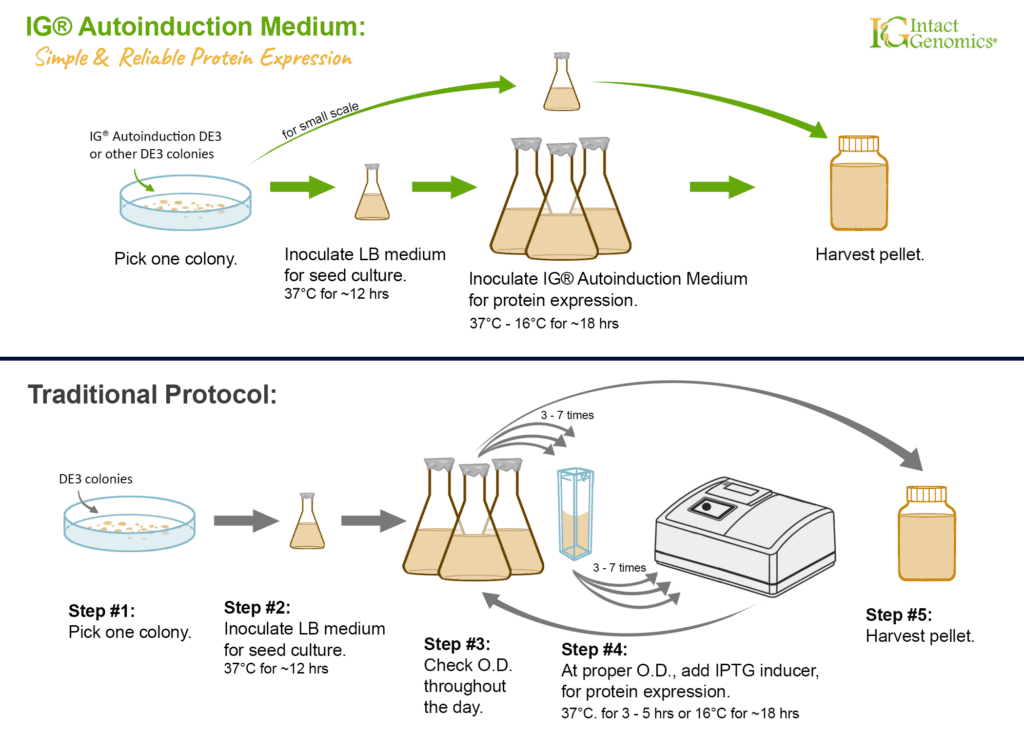
Intact Genomics (IG®) Autoinduction Medium promotes high-yield growth of E. coli and high-level expression of T7 promoter-regulated recombinant proteins without time-consuming steps such as monitoring optical density (OD) or adding induction components like IPTG.

Unlike traditional LB-IPTG induction systems, IG® Autoinduction Medium allows regulated protein expression in any expression system that is solely inducible by IPTG from E. coli strains containing a fully functional lac operon.

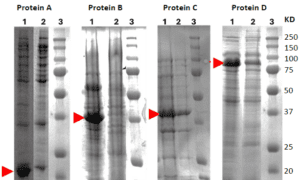
We have also developed an Autoinduction DE3 strain. Both chemical (catalog # 1065) and electroporation (Catalog # 1265) competent cells are available. These cells have been used to test a broad variety of protein targets resulting in robust protein expression and production (Figure 1). Protein expression begins automatically after inoculation with a single colony or starter culture. After an incubation time of ~7 hours, the culture is shifted to a lower temperature overnight for continued growth and protein expression under standard conditions.


Key Benefits:
Simple & Fast: No need for frequent OD600 monitoring or manually adding an inducer—freeing your time to focus on other tasks.
Repeatable: Reliable, consistent protein expression by reducing: leaky expression, vector instability, and challenges with toxic proteins.
High-Yield: Achieve high cell density and robust protein expression with ease.
Flexibility: Compatible with other DE3 strains and media for seamless integration into your workflow.


Product Components:

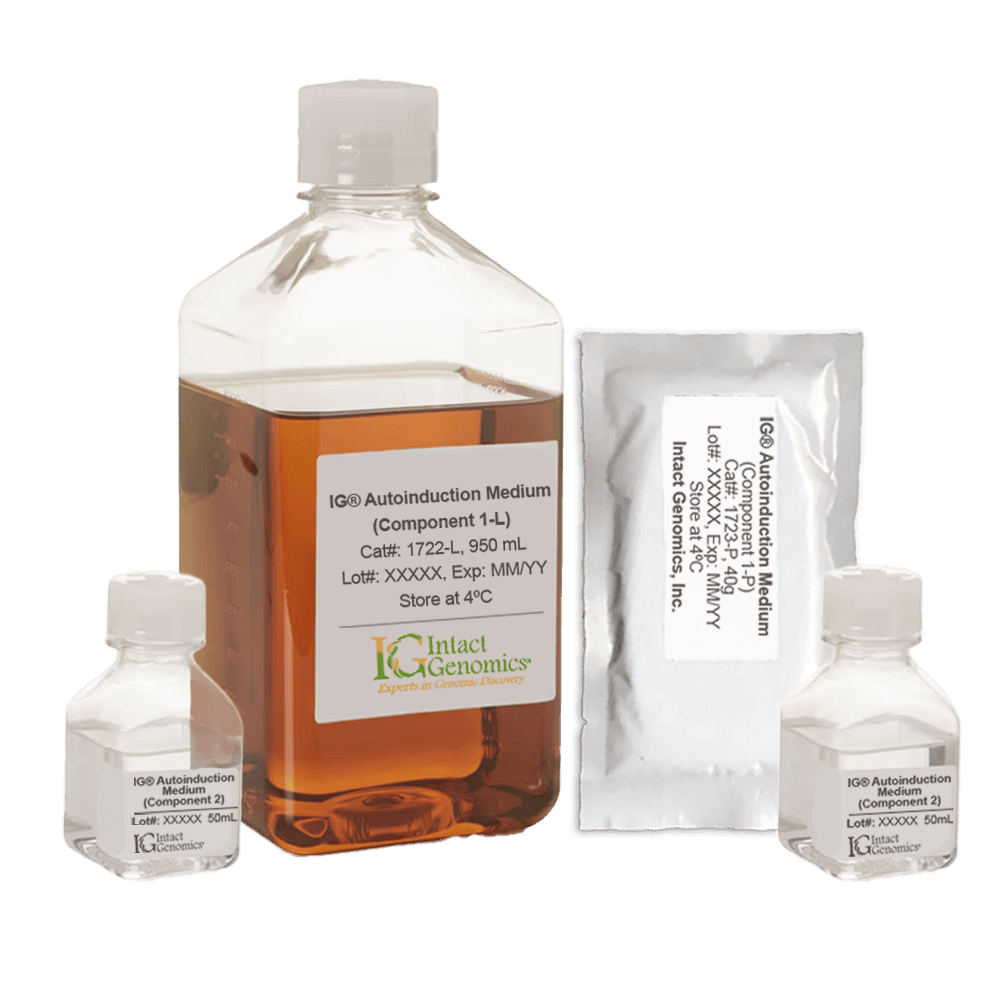
Component 1 (in one of two optional formats):
1-L: liquid, 950 mL
1-P: powder, 40 grams
Component 2: 50mL

Package Formats: Component 1-L: bottle; Component 1-P: bag; Component 2: bottle
Shipping Condition: Room Temperature


Storage: 4°C


Vectors and Bacterial Strains

IG® Autoinduction Medum is designed for inducible T7 promoter-regulated protein expression systems. IG® Autoinduction DE3 strain is optimized and shows a higher success rate using IG® Autoinduction Medium and simple growth conditions than other types of BL21(DE3) strains below. T7 promoter-regulated expression vectors (such as pET) are suitable for cloning your gene of interest. E. coli expression strains that contain a fully functional lac operon (including lacY and lacZ) such as BL21(DE3), and BL21(DE3)pLysS strains can be used with IG® Autoinduction Medium.

Important Tips: Some E.coli expression strains including T7-regulated expression systems with a partially functional lac operon (such as NEB T7 expression strain), and E. coli cloning strains such as DH10B, DH5alpha, etc. CANNOT be used for autoinduction of protein expression.


IG Autoinduction Medium Preparation

IG® Autoinduction Medium (1L medium) component 1 comes with two formulas: liquid Component 1-L (ready-to-use), and dry power, Component 1-P. Component 2 is a sterile liquid and ready to be added into Component 1.

For Liquid, Component 1-L (ready to use):

Inside a clean/sterile hood, use aseptic technique to add selective antibiotic of choice (e.g. 50 μg/mL kanamycin) depending on the resistance gene in your vector to Component 1 (950 ml), mix well. Your IG Autoinduction Medium is completed and ready to use.

Notes: If a precipitate is visible in Autoinduction Medium Component 2, it can be re-dissolved by warming at 37°C and gently shaking or swirling the bottle until the precipitate is gone. Then add it to Component 1 as described above. The formation of precipitate will not affect product performance. Keep unused complete medium at 4°C for up to 3-4 weeks.

For Dry Powder, Component 1-P:

1. Completely dissolve the entire bag of Autoinduction Medium Component 1-P in 950 mL of de-ionized water in an autoclavable flask.
2. Autoclave on a liquid cycle for 15 minutes. Cool media to room temperature.
3. Inside a clean/sterile hood, use aseptic technique to add Component 2 (50mL) of IG Autoinduction Medium, selective antibiotic of choice (e.g. 50 μg/mL kanamycin) depending on the resistance gene in your vector to Component 1 (950 mL) , mix well. Your IG autoinduction medium is completed and ready to use.

Protocol:

Tips: Culture tube/flask/vessel size and culture conditions

  1. Optimal aeration of the culture during incubation is critical to achieve high-density growth.
  2. IG Autoinduction Medium expression cultures must be incubated with vigorous shaking at 250 rpm in an appropriately sized tube, flask, or vessel.
  3. For small-scale expression cultures, add 1 mL complete IG Autoinduction Medium to a sterile 15 mL culture tube.
  4. For larger volumes in a non-baffled or baffled flask, use 10%–20% of the flask volume as complete IG Autoinduction Medium.
  5. Culture at 37°C.

Starter culture: A starter culture is recommended for Autoinduction Medium expression culture volumes >100 mL. To make a starter culture, inoculate 1/15 of the final culture vessel volume of LB media with selective antibiotic with fresh colony or glycerol stock and grow overnight with shaking at 30°C. For expression culture volumes of <100 mL, directly inoculate Autoinduction Medium with a fresh colony or glycerol stock. Simple protocol:

1. Add complete IG® Autoinduction Medium to sterile tubes or flasks according to the culture vessel size recommendations above.

2. Use sterile technique to inoculate the colony directly into the medium. Be sure to patch the colony onto a separate selective plate if needed. If you are using a starter culture, add the entire volume to the Autoinduction Medium culture flask using aseptic technique.

3. Cap tube or flask and secure in an incubator. 4. Incubate at 37°C or 30°C with vigorous shaking (250 rpm) for 18-24 hours. Enhanced protocol: Protein expression cells can be grown at 37°C or 30°C, for ~7 hours (O.D. 600 = ~7.0.) at 250rpm from a starter culture then shift to18ºC autoinduction overnight for 13-19 hours. This protocol is for specific applications related to protein solubility and toxicity or robust yield of both cells and target protein.

Day 1:

1. Inoculate 10-200 mL LB/antibiotic with an expression colony and incubate overnight at 30°C with vigorous shaking (250 rpm). 2. Place the appropriate amount of complete Autoinduction Medium/antibiotic at 37°C or 30°C to pre-warm it ~1 hour (ideally, not required).


Day 2:

1. Inoculate pre-warmed, complete Autoinduction Medium /antibiotic with an overnight seed culture at a 1:15 dilution.

2. Incubate the culture with vigorous shaking (250 rpm) at 30/37°C for ~7 hours or until O.D. 600 = ~7.0.

3. Transfer the culture to an incubator set at either 18°C with vigorous shaking (250 rpm), then incubate for 13-19 hours.

Days 3:

Harvest culture and analyze recombinant protein expression. Important Tips:

An overnight starting culture in rich medium such as LB or 2YT at 37oC usually reached saturation by the next morning. Which might result in the plasmid instability because of the basal leakage of the T7 expression system and poor yield of target protein. To avoid this issue, starting culture in a rich medium for ~5 hours at 37oC or overnight at 20–25oC or 30oC until the OD600 was between 3-5 in LB or 5-7 in 2YT is strongly recommended. Optimize Lysis Conditions: Under the growth conditions specified above, E. coli expression or IG® Autoinduction ED3 strains usually grow to 3-5 times or more optical density in Autoinduction Medium compared to traditional medium. To ensure efficient bacterial lysis using your method of choice, you will need to estimate the amount of E. coli cells in your expression culture. Dilute an aliquot of the expression culture 1:20 in water and measure the O.D. 600 to calculate the approximate cells/mL, and optimize your lysis conditions accordingly.


Downloads

IG AutoInduction Medium Manual_v2.0Manual – IG Autoinduction Medium
MSDS – IG Autoinduction Medium_Liquid
MSDS – IG Autoinduction Medium_Powder
Certificate of Origin – IG® Autoinduction Medium


If you cannot find the answer to your problem then please contact us or telephone +44 (0)1954 210 200

Support Links

  • Home
  • Products
  • Special Offers
  • Distributors
  • Suppliers
  • About Us
  • News
  • Technical Help
  • Contact Us
  • My Account
  • Terms & Conditions
  • Privacy Policy