IG® Stable 2 Electrocompetent E. coli Cells
Stable 2 cells are capable of cloning methylated genomic sequences, retroviral sequences and direct repeat sequences.
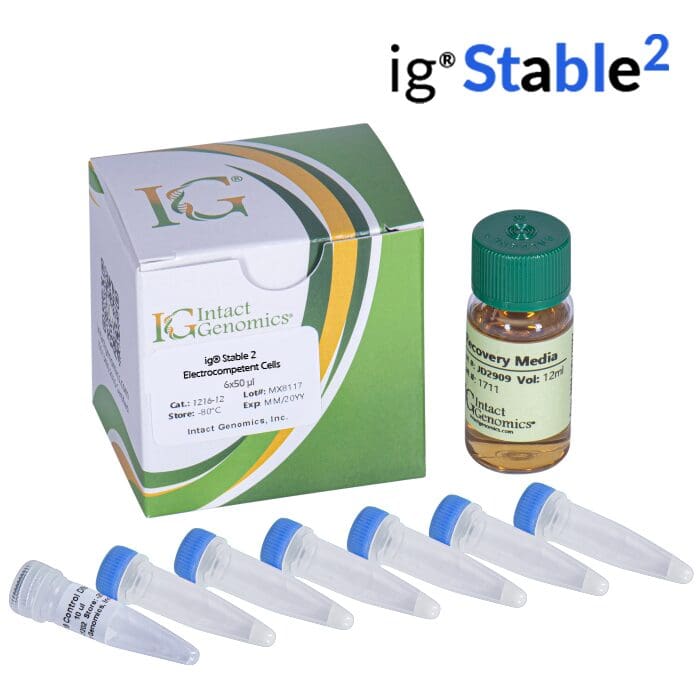
Product Description
Intact Genomics (ig®) Stable 2 Electrocompetent E. coli cells offer the highest transformation efficiencies of ≥2 x 10¹⁰ cfu/µg plasmid DNA which are ideal for applications requiring high transformation efficiencies, such as cDNA or gDNA library construction. Stable 2 cells are capable of cloning methylated genomic sequences, retroviral sequences and direct repeat sequences. Intact Genomics Stable 2 cells provide superb transformation efficiency, allowing for increased opportunity for experimental success.
Custom Aliquots Available
Specifications
Competent cell type: Electrocompetent
Species: E. coli
Format: Tubes
Transformation efficiency: ≥2 x 10¹⁰ cfu/µg pUC19 DNA
Blue/white screening: No
Shipping condition: Dry ice
Reagents Needed for One Reaction
ig® Stable 2 Electrocompetent Cells: 25 µl
DNA (or pUC19 Control, 10 pg/µl): 1 µl
Recovery medium: 1 ml
Storage
ig® Stable 2 Electrocompetent Cells: -80 ºC
pUC19 control DNA: -20 ºC
Recovery medium: 4 ºC
Genomic Features
ig® Stable 2 Electrocompetent Cells have the following features:
- Stable 2 allows for cloning of methylated genomic sequences
- Stabilizes retroviral and direct repeat sequences including HIV
- High transformation efficiency allows aids in cloning rare sequences
- May be used for plasmids > 20 kb
- endA1 mutation increases plasmid yield significantly
Genotype
F- mcrA Δ(mcrBC-hsdRMS-mrr) recA1 endA1lon gyrA96 thi supE44 relA1 λ- Δ(lac-proAB)
Quality Control
Transformation efficiency is tested by using the pUC19 control DNA supplied with the kit and using the protocol given below. Transformation efficiency should be ≥2 x 10¹⁰ CFU/µg pUC19 DNA. Untransformed cells are tested for appropriate antibiotic sensitivity.
General Guidelines
Follow these guidelines when using ig® Stable 2 Electrocompetent Cells:
- Handle competent cells gently as they are highly sensitive to changes in temperature or mechanical lysis caused by pipetting.
- Thaw competent cells on ice and transform cells immediately following thawing. After adding DNA, mix by tapping the tube gently. Do not mix cells by pipetting or vortexing.
Note: A high-voltage electroporation apparatus such as Bio-Rad Gene Pulser II #165-2105, capable of generating field strengths of 16 kV/cm is required.
Example Calculation of Transformation Efficiency
Transformation Efficiency (TE) is defined as the number of colony forming units (cfu) produced by transforming 1µg of plasmid into a given volume of competent cells.
TE = Colonies/µg/Dilution
Transform 1 µl of (10 pg/µl) pUC19 control plasmid into 50 µl of cells, add 950 µl of Recovery Medium. Dilute 10 µl of this in 990 µl of Recovery Medium and plate 50 µl. Count the colonies on the plate the next day. If you count 100 colonies, the TE is calculated as follows:
Colonies = 100
µg of DNA = 0.00001
Dilution = 50/1000 x 10/1000 = 0.0005
TE = 100/.00001/.0005 = 2.0×10101216-12 1216-24
Use this procedure to transform ig® Stable 2 electrocompetent cells. Do not use these cells for chemically transformation.
1. Place sterile cuvettes and microcentrifuge tubes on ice.
2. Remove competent cells from the -80 °C freezer and thaw completely on wet ice (10-15 minutes).
3. Aliquot 1 µl (1 pg-10 ng) of DNA to the chilled microcentrifuge tubes on ice.
4. When the cells are thawed, add 25 μl of cells to each DNA tube on ice and mix gently by tapping 4-5 times. For the pUC19 control, add 1 µl of (10 pg/µl) DNA to the 25 µl of cells on ice. Mix well by tapping. Do not pipette up and down or vortex to mix, this can harm cells and decrease transformation efficiency.
5. Pipette 26 µl of the cell/DNA mixture into a chilled electroporation cuvette without introducing bubbles. Quickly flick the cuvette downward with your wrist to deposit the cells across the bottom of the well and then electroporate.
6. Immediately add 974 µl of Recovery Medium or any other medium of choice to the cuvette, pipette up and down three times to re-suspend the cells. Transfer the cells and Recovery Medium to a culture tube.
7. Incubate tubes at 37 °C for 1 hour at 210 rpm.
8. Dilute the cells as appropriate then spread 20-200 μl cells onto a pre-warmed selective plate. For the pUC19 control, plate 50 μl of diluted transformants onto an LB plate containing 100 μg/ml ampicillin. Use sterilized spreader or autoclaved ColiRoller™ plating beads to spread evenly.
9. Incubate the plates overnight at 37 °C.
Downloads
Manual – Stable 2 Electrocompetent Cells
MSDS – Stable 2 Electroporation Cells
If you cannot find the answer to your problem then please contact us or telephone +44 (0)1954 210 200