Ames Test Kit in 6 Well Agar Plates for 5 Strains - MicroAmes6 Penta 4
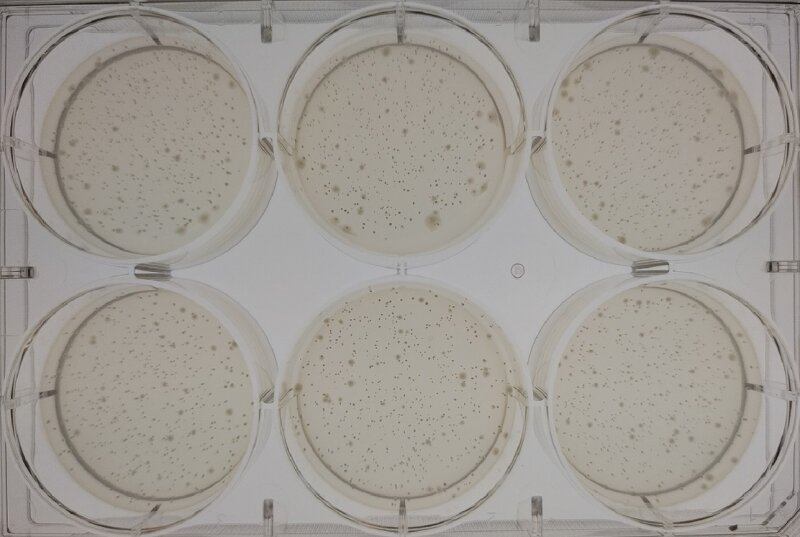
Kit includes reagents for testing 2 Samples if tested in 5 strains, 3 Replicates, 6 Dilutions, /- S9, Negative, Positive and Sterility Controls.
- 5 Strains: TA98, TA100, TA1535, TA1537, E.coli uvrA pKM101
- 2 x 1 mL Rat liver S9
- Positives Controls: 2-Nitrofluorene, 4-Nitroquinoline-N-Oxide, N4-Aminocytidine, 9-Aminoacridine, 2-Aminoanthracene
- Ampicilline
- Buffers, Media
- Agar for minimal glucose plates, top agar
Not included in the kit: S9 cofactor solutions, plastic ware
Scientific Background of the Ames Test
Salmonella strains with specific genetic modifications are used in the Ames Test, they are unable to grow without the amino acid histidine (his- genotype). Only Salmonella strains that have undergone a genetic mutation, i.e. a mutagenic reversion to histidine prototrophy can survive and grow in absence of histidine (his genotype). Thus, only in the presence of mutagenic compounds, an increase in back-mutations occur to this his genotype. The Salmonella colonies which are growing on agar plates or in liquid media, are called “revertants”. An increased number of revertants in relation to the strain-specific spontaneous mutation rates obtained with the solvent control is a clear indication for a mutagenic test substance. See also OECD TG471.
Many mutagenic compounds are only mutagenic upon metabolization. The Salmonella strains which do not have a metabolic system are therefore exposed to a test compound in the presence of microsomal fraction S9 of a rat liver homogenate.
Test Principle of the Ames Test
Bacteria are exposed to different concentrations of a test sample, as well as a positive and a negative control in a medium containing limited quantities of histidine (S. typhimurium) to support approximately two cell divisions. The cultures in each condition (negative control, test samples and positive controls) are poured in 6 well plates. The cells are exposed to the compound in absence and presence of S9. Rat liver post mitochondrial S9 fraction mimics the effect of the chemical after metabolization. Within three days, cells that have undergone a genetic reversion event to amino acid prototrophy will grow and form colonies. The revertant counts will be compared to those grown in the solvent (negative) control wells. A dose-dependent and significant increase in the number of revertant colonies upon exposure to test sample relative to the solvent controls indicates that the sample is mutagenic. A sterility plate for S9 and buffer is used a contamination control.
Service analytics for early drug discovery with test compound, ( /- S9) with the MicroAmes6 assay system is available as well under GLP and non GLP conditions, please contact info@xenometrix.ch.
Characteristics of the Ames Test Kit MicroAmes6 Penta 4
- Quality controlled products: all products included in the kit are quality controlled according to OECD TG471
- Certificate of Analysis: Provided with each kit
- Enough Material to process 2 compounds per individual strains, /- S9
- Reagents for the preparation of agar plates included in the kit to allow long term storage of the kit (> 10 months)
- Shipped at Room Temperature from external Storage in Germany or from Switzerland
- 4 times less test compound as compared to the Ames Test in Petri Dishes
- Less hands-on-time and simultaneous processing of several replicates
- Waste - Significant less plastic waste and thus reduced contaminated waste in environment
- Analytical services available, please contact info@xenometrix.ch
If you cannot find the answer to your problem then please contact us or telephone +44 (0)1954 210 200